


You're trying to organise a Manchester night out and have hit the usual dead end. One person wants food, another wants something competitive, someone else refuses another loud bar, and nobody wants to spend the evening staring at a restaurant booking screen. Adventure dining solves that awkward compromise by turning the meal into the activity.
Instead of sitting down once and calling it a night, you follow clues through the city, discover independent food stops, and let the route shape the conversation. Manchester is particularly well suited to the format, thanks to its compact central neighbourhoods, varied independent venues, and streets that reward anyone willing to look beyond the obvious entrance.
Table of Contents
- A Friday Night in the Northern Quarter
- What Adventure Dining Means
- How a Clue-Led Route Works from Start to Finish
- Who Adventure Dining Is Really Built For
- Three Manchester Occasions That Click
- Why Food Escapes Is the Format's Manchester Flagship
- Booking Tips, Group Sizes, and Accessibility
- Try It, Map It, Plan a Date Around It
A Friday Night in the Northern Quarter
Stevenson Square is doing its usual Friday impression of controlled chaos. Six people weave past the queues outside Mackie Mayor, coats damp from a brief Manchester shower, phones tilted towards the same WhatsApp thread.
They're not waiting for a table. They've already eaten the first course.
The next clue points towards a back-alley bao bar whose door sign appears to mention soup and very little else. One player has cracked the location. Another is insisting the answer is an anagram. A friend-of-a-friend has joined after a late train from Oxford Road and is trying to work out whether they're allowed to touch the phone.
Then the timer pauses.
That small silence matters. The group has been mildly panicked for the last few minutes, checking street names, comparing theories, and walking in increasingly confident circles. When the next dish lands, everyone relaxes at once. The puzzle can wait. The food is here.

That's adventure dining, and it works because the evening has a rhythm. You solve, walk, arrive, eat, argue about the clue, and set off again. Nobody needs to manufacture conversation because the city keeps supplying material.
A route through the Northern Quarter feels different from a standard meal out. You notice side streets you normally ignore. You start reading signs, shopfronts, murals, and building details as part of the menu. A wrong turn becomes a story rather than a wasted taxi fare.
Manchester's food scene gives the format plenty to work with. The city's food and drink scene includes destinations around the Great Northern Warehouse, Peter Street Kitchen, Adam Reid at The French, Canto, and Sexy Fish, as highlighted by Visit Manchester's food and drink guide. The strongest clue trails, though, use the places between the obvious landmarks.
What Adventure Dining Means
Adventure dining combines a food tour, an escape game, and a multi-course meal. The clearest way to grasp it is to compare the format with familiar nights out.
With a takeaway, food arrives at home and the experience stays there. Adventure dining spreads the meal across the city, with clues deciding where you go next. The streets form part of the game board, giving the route its structure.
A standard food tour usually follows a guide in real time. That works well when you want local stories delivered as you walk, but the guide controls the pace. A clue-led route puts the next instruction on your phone. Your group chooses how to tackle the puzzle and moves on when ready. WhatsApp-based delivery makes that format particularly practical, keeping clues, updates, and decisions in the same channel without requiring a guide to shepherd the group.
A tasting menu centres on one chef, one kitchen, and one room. Adventure dining distributes the meal among independent venues, with each stop chosen for a particular dish or cuisine. You compare the character of different places across one neighbourhood, rather than courses from a single kitchen.
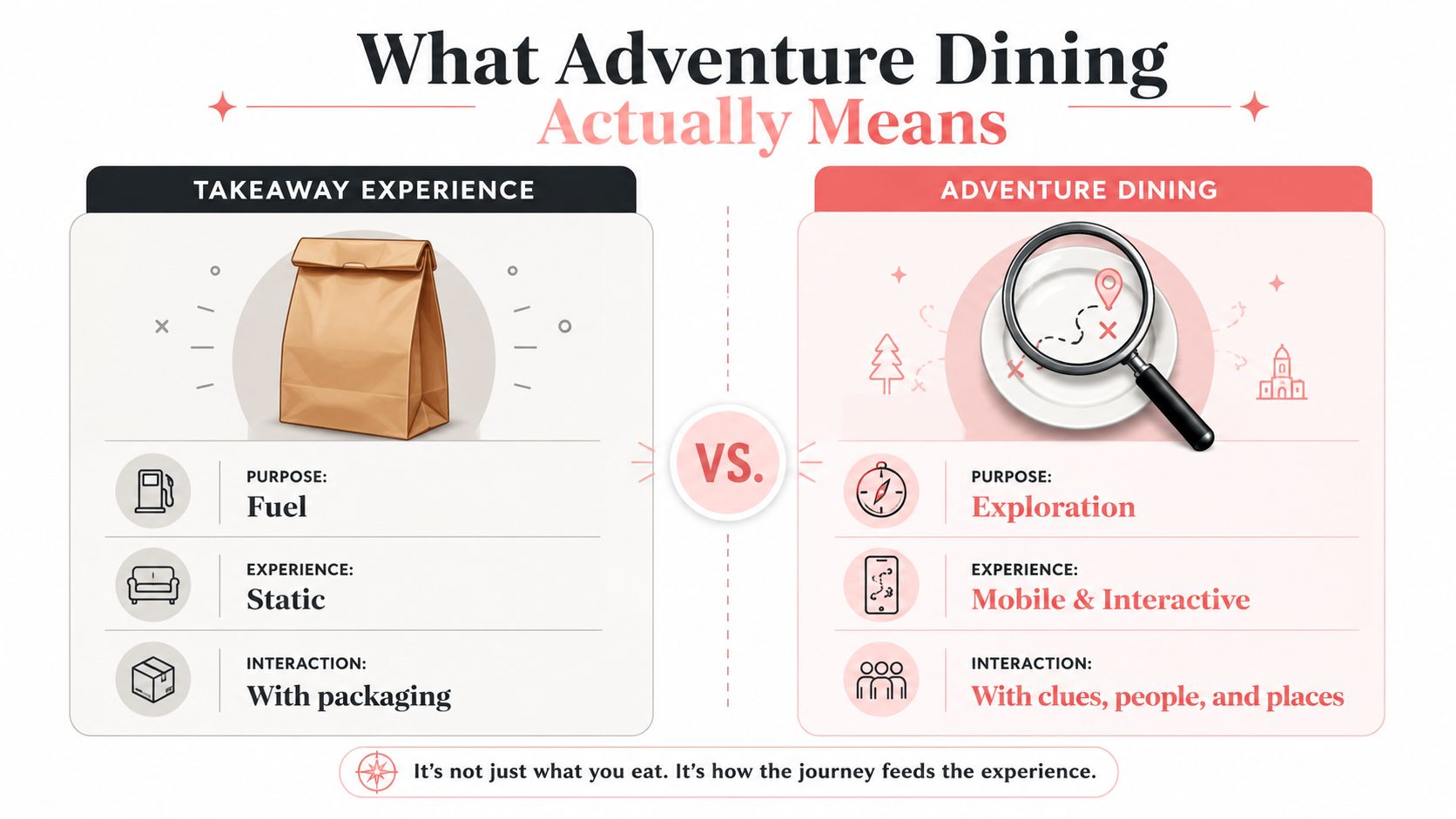
A useful working definition is:
Adventure dining is a clue-led, multi-stop meal where the route, puzzle, and food are designed as one product.
That separates the format from a restaurant adding a quiz night or a tour operator handing out trivia. The meal rewards you for solving the city. It is not a separate booking attached to a walk.
The commercial case is clear in the UK. The culinary tourism market generated USD 943.2 million in 2023 and is forecast to reach USD 3,086.2 million by 2030, with a projected 18.5% CAGR from 2024 to 2030. The UK culinary tourism outlook identifies culinary trails as the fastest-growing activity segment.
That direction favours products combining food with exploration. It also explains why a three-stop route can feel better value than one reservation occupying the same evening: you receive a meal, a neighbourhood route, and a shared puzzle.
How a Clue-Led Route Works from Start to Finish
Manchester weather, late trains, and one friend still in Piccadilly Gardens can derail a dinner plan. A good clue-led route accounts for that before the group sets off, then keeps the food, walking, and puzzle moving in a clear sequence.
1. Book online and confirm
Choose the date and route, then add dietary information during booking. Confirmation should include a starting window, not an instruction to arrive at one exact second. That small amount of flexibility suits Manchester groups, where work finishes unpredictably and trains rarely respect the plan.
Check the starting area before booking, especially if anyone needs step-free access or a short route from public transport.
2. Arrive at the first stop
The group checks in at the opening venue and receives its first clue. Food comes from a pre-set menu, so the kitchen can prepare the dish and nobody loses time studying a full restaurant menu.
The first plate sets the rhythm. It also gives everyone a low-pressure chance to understand the clue style before the harder answers appear.
3. Solve, walk, and pause the timer
After the first dish, the next clue sends the group into nearby streets. It may require a building detail, a careful reading of the wording, or a feature that many people pass without noticing.
The timer should pause while you eat. That decision protects the meal. Without the pause, diners rush through each venue and treat restaurants as fuel stops. With it, the puzzle drives the walk between dishes while the food remains part of the evening.
Practical rule: nominate one phone holder, but make every clue a group decision.
Keep the route flexible enough for a weather adjustment, a warm-up stop, or a slower pace. You are exploring independently rather than following a guide through the city.
4. Follow the middle stops
Middle clues usually change difficulty. Some are quick wins. Others catch people because the obvious answer is nearly correct, but misses one detail. Around Manchester, signs, alleys, building names, and small visual features can all provide evidence.
Set a clear phone role before leaving. One person can hold the device and read incoming instructions, while the whole group checks the answer. That approach limits screen time without losing the convenience of WhatsApp.
Groups needing extra arrival or entrance support can use guidance on turn by turn navigation for venues. For a closer examination of the format's wider mechanics, read this guide to exploration games.
5. Finish with the final dish
The last venue often serves dessert or a signature dish. A final clue closes the trail and gives the group a definite finish, rather than leaving everyone unsure whether the activity has ended.
Food Escapes presents the experience as self-guided. One Manchester listing describes a WhatsApp-led puzzle lasting 3 hours, with food at 3 independent venues, suitable for ages 9 to 100, and no guide or host. A regional review describes another run taking about two and a half hours, beginning in the Northern Quarter, with a one-minute penalty for a wrong answer. See the relevant Manchester food puzzle listing for those route details.
Who Adventure Dining Is Really Built For
Adventure dining works best when you choose it for the occasion, not because a marketing page says it suits everyone.
Date nights
A date can lose energy when one person carries the conversation and the other studies the menu. Clues create natural prompts without forcing either of you into an awkward icebreaker. You'll have something to solve together, streets to comment on, and dishes to debate.
It's especially useful for an early date because movement removes the pressure of maintaining eye contact across a table. It also gives established couples a reason to leave the familiar restaurant circuit.
Friend groups
Friends who are bored of choosing between a pub and a film get a shared activity with built-in food. Mixed personalities can contribute in different ways. One person spots visual details, another handles wordplay, and the competitive one keeps an eye on the clock.
The social concern around technology deserves attention. UK research found 31% of consumers worry that more technology in hospitality makes experiences less social, while only 9% were excited about VR dining. The same research found 44% would spend more on a unique dining experience and 28% would visit regularly if an immersive option became more accessible, according to Grafterr's UK consumer research summary.
WhatsApp-based gameplay is the sensible middle ground. It uses a familiar tool without replacing conversation with headsets, screens, or a staged spectacle.
Teams and tourists
Small work groups can solve clues without the forced enthusiasm of formal team-building exercises. Tourists get structure without the scripted feel of a bus tour, while locals gain a reason to inspect neighbourhoods they think they already know.
Dietary-restricted guests should also fit into the format when the booking process captures requirements early. Non-drinkers aren't treated as an afterthought because the activity doesn't depend on alcohol to create momentum.
The format isn't for everyone. Skip it if you want a quiet seated meal, if your group is too large to discuss clues properly, or if walking roughly two miles across a city centre sounds like a chore.
For puzzle-focused group ideas beyond dining, the problem-solving games guide offers useful context.
Three Manchester Occasions That Click
The same route can do different jobs depending on who's walking and why. These three scenarios show where adventure dining earns its place over a conventional booking.
Three Manchester Occasions Side by Side
| Occasion | Group Size | Walking Distance | Total Time | Best Start Time |
|---|---|---|---|---|
| Friday date night in Ancoats | 2 | Roughly 2 miles | About 2 hours | Early evening |
| Monday team outing from Spinningfields | 6 | Roughly 2 miles | About 2 to 3 hours | After work |
| Saturday family afternoon in the Northern Quarter | 4 | Roughly 2 miles | About 2 to 3 hours | Early afternoon |
The Ancoats date night
Start in Ancoats, where the route can turn a familiar dinner into a sequence of small discoveries. Three stops over roughly two hours gives a first date enough structure without swallowing the entire evening.
The best conversations happen while walking between venues. You can discuss the clue, the last dish, and whether the next answer is hiding in plain sight. Finish close enough to a cocktail bar for one more drink, or switch to a soft drink and keep the night moving without committing to another full meal.
The Spinningfields product squad
A six-person team based near Spinningfields needs an activity that doesn't split the room into the loud and the silent. Shared clue-solving gives introverts a concrete contribution and extroverts something useful to organise.
The strongest moment usually arrives when the group stops overthinking an answer. Someone notices a detail near the route, the team agrees, and everyone moves together. That beats a round of compulsory introductions because the interaction has a real purpose.
The Northern Quarter family afternoon
A Saturday route through the Northern Quarter suits families with older children who can handle the walking and enjoy a little competition. With two teenagers and one coeliac diner, dietary notes need to travel with the booking so every venue is prepared before the group arrives.
The practical win is social as much as culinary. Nobody has to sit outside a venue while the others eat, and the teenagers get an activity that doesn't feel like a children's attraction. The streets around Stevenson Square provide enough visual detail to make the route feel like exploration rather than a series of restaurant entrances.
Why Food Escapes Is the Format's Manchester Flagship
Start in Chinatown, finish around the Northern Quarter, and let the route do more than connect restaurants. Food Escapes has shaped its Dumpling Trail around these walkable Manchester neighbourhoods, linking three independent food stops with dumpling-led dishes included in the ticket. Clues reveal each venue, so the meal arrives in stages rather than as one booking at one table.
WhatsApp is the quiet superpower. Each clue appears as a push notification, one at a time, on a phone the group already knows how to use. The game clock pauses while everyone eats, so solving quickly never becomes the priority over enjoying the food. There is no guide with a flag and no new app to download.
The format works because the technology stays out of the way. A wrong answer adds light competition, while the route keeps the group moving through streets locals use on a Saturday night. The Manchester Evening News review also presents it as a WhatsApp-led treasure hunt beginning in the Northern Quarter, which matches the product's practical appeal.
Check the current rating profile before booking, since ratings change. The stronger trust signal is the design itself: food, independent venues, clues, and Manchester streets are planned as one experience.
That separates Food Escapes from operators that add a few puzzles to an existing food tour or place riddles between pub stops. The structure suits tourists, couples, families with older children, and anyone who wants a food-led activity without alcohol. It gives hosts a useful model too. ScanStay's restaurant guide for hosts explains how recommendations can reflect guest needs and local context, the same practical thinking that makes a neighbourhood route work.
Explore the operator's Food Escapes experience page for its wider selection of themed routes.
Booking Tips, Group Sizes, and Accessibility
Treat booking like packing for a Manchester night out. The weather, the people coming, and everyone's appetite will determine whether the route feels effortless or unnecessarily difficult.
Most clue-led routes are designed for 2 to 8 players, with 3 to 5 usually the most comfortable group size. Three players can discuss every clue. Five gives you a useful spread of puzzle skills. Larger groups often split into side conversations and slow the decision-making.
Sort the practical details first
- Book busy slots early: Thursday to Saturday routes disappear faster during popular periods, particularly around Christmas markets.
- Flag dietary needs at checkout: Vegan, halal, nut-free, and coeliac requirements should reach every venue before the group arrives.
- Ask about step-free routing: Most Northern Quarter and Ancoats stops can work for wheelchair users, but cobbled stretches around the Shambles may be difficult. Contact the operator for a flatter alternative.
- Check the walking expectation: If anyone has mobility limitations, ask for the route profile rather than assuming a city-centre trail is automatically easy.
- Bring the essentials: Wear weatherproof layers, carry a charged phone, leave bulky bags behind, and arrive ten minutes early.
That early arrival gives you time to settle, grab a hot drink, and read the first clue without a queue forming behind you. It also prevents the familiar Manchester mistake of entering the wrong side street with confidence.
Accessibility check: dietary suitability and physical accessibility are different questions. Confirm both before paying.
Choose the route length around the occasion. A shorter loop is kinder to a first date or a group with younger participants. A fuller trail suits a birthday, visitor itinerary, or team outing where the activity is the main event.
Try It, Map It, Plan a Date Around It
Anchor your first adventure dining night to something already in the diary. A mate's birthday, a Friday off, or a post-work gap between 6pm and 9pm gives the route a natural reason to exist instead of making it compete with an overstuffed evening.
Pick the shorter loop for a first date. Choose the longer Dumpling Trail when you want the food adventure to carry the evening. Meet at Piccadilly Tap for a quick pint before starting, or reserve a late cinema at HOME afterwards so the route has a beginning and an ending.
The Northern Quarter works particularly well for extending the night. Stevenson Square and Tariff Street give you plenty of options for a final drink, coffee, or a slower conversation after the last clue lands. Budget for the ticket and two drinks each, then decide whether the route itself replaces dinner, a separate activity, or both.
Manchester's wider market supports that choice. The Howden Group summary of experiential dining reports that 42% of diners were more interested in experiential dining than the previous year, while a later UK restaurant-trends report said experiential dining rose 19% year over year in 2025 and that 31% of Brits want more of it in 2026. Those figures point towards a shift from meals as static bookings to meals as social occasions with a story.
If the format clicks, try a second neighbourhood rather than repeating the same route. Compare how Ancoats handles discovery with the Northern Quarter, then work out which city experience your group prefers.
Food Escapes offers WhatsApp-led adventure dining in Manchester, including the Dumpling Trail through Chinatown and the Northern Quarter, with clues, three independent food stops, and food included in the ticket. Visit Food Escapes to choose a route, check availability, and turn your next date, birthday, tourist day, or group night into something you'll still be talking about afterwards.

0 comments