


You're trying to keep children busy, but you also want the activity to do something useful. A good challenge gives them a reason to think, test, tweak and try again, and that usually lands better than another worksheet. The best problem solving activities for kids can be loud or quiet, indoor or outdoor, screen-based or hands-on, and they can fit a rainy afternoon, a classroom slot, a birthday party or a family day out. If you want a broader set of ideas alongside puzzles and games, engaging STEM activities for kids is a useful extra read.
The easiest way to choose is to match the activity to the moment you've got. If you've got ten minutes, pick a riddle or a quick logic puzzle. If you've got a free morning, go for a scavenger hunt, a building challenge or a food-led route through the city. If you want teamwork, choose something with clues, roles and a shared goal. Every idea below includes a simple way to run it, what it needs, the best age range, the main learning payoff and a few ways to make it easier or harder.
A strong starting point is also to think about what children are already drawn to. Some love maps and movement, some want code and screens, some prefer making things, and some stay engaged when food is part of the reward. In the UK, that mix matters, because family activities have to compete with outdoor time and digital entertainment, and children's preferences vary a lot by age and setting. The point is not to make every task complicated, it's to make the thinking visible and the win satisfying.
Table of Contents
- 1. Treasure Hunt and Scavenger Hunts
- 2. Escape Room Challenges
- 3. Coding and Programming Challenges
- 4. Building and Construction Challenges
- 5. Logic Puzzles and Sudoku
- 6. Cooking and Recipe Challenges
- 7. Word Games and Riddle Solving
- 8. Science Experiments and Hypothesis Testing
- 9. Map Reading and Navigation Challenges
- 10. Group Collaboration and Team Challenges
- 10-Item Comparison: Kids Problem-Solving Activities
- Choose the Challenge That Fits Your Child
1. Treasure Hunt and Scavenger Hunts
Treasure hunts are one of the easiest problem solving activities for kids to set up because the challenge is built into the route. Children read clues, spot landmarks, decode riddles and work out where to go next, which turns simple movement into real reasoning. That fits the UK well too, because official child development data shows problem solving is already being measured nationally at a very early age, with 92.5% of children aged 2 to 2 and a half years in England reaching the expected level in 2023 to 2024, and outcomes varying by region rather than looking identical everywhere, according to the government's child development statistics.
A ready-to-run version works well at a birthday party, in a park or around a museum. In Manchester, you could build it around a local green space, a community centre, or a visit to Scavenger Hunt Manchester, especially if you want a clue trail that feels local rather than generic. Food Escapes adapts the idea neatly for families by combining clue-solving with visits to three hidden-gem restaurants, so the hunt ends in a meal instead of a prize bag.
Practical rule: make the clues feel solvable, but not obvious. If every child can spot the answer instantly, the activity becomes a walk, not a challenge.
What to use: printed clues, a pen, a phone for photos if you want a record, and a few small checkpoint rewards.
Best ages: roughly 5 to 12, with picture clues for younger children and word clues for older ones.
How to tweak difficulty: use multiple solution paths, mix physical searching with a bit of logic, and test every clue before the group starts.
What children practise: spatial awareness, teamwork, persistence and clue interpretation.
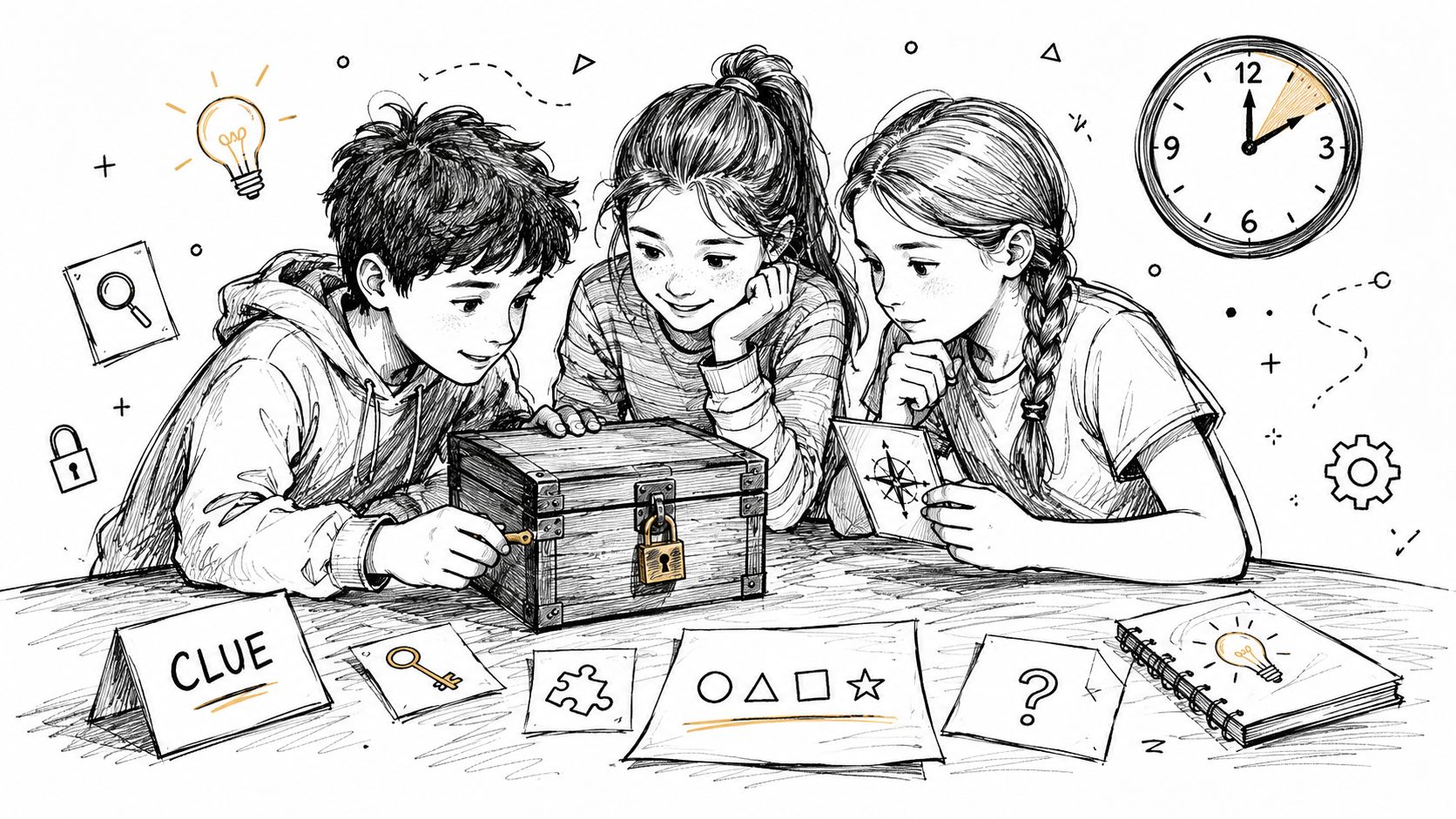
2. Escape Room Challenges
A locked-room clue trail gives children a clear shared task. They spot details, test ideas and talk through what they have found, which feels different from working alone on a worksheet. That social format also matches what the OECD found in its PISA 2015 collaborative problem solving assessment, where 15-year-olds in England scored 521 points, above the OECD average of 500, with 22% not demonstrating basic collaborative problem solving ability and 13% reaching an advanced level, according to the national report.
For families in Manchester city centre, themed rooms at places such as Escape Hunt or Quest Rooms give that pressure-cooker feel in a controlled setting. A quieter family slot helps younger children keep up, and paper plus a pen lets them note symbols, sequences or half-finished ideas without losing track. If you want the same clue-led structure without the locked-door setting, family-friendly escape rooms in Manchester show how Food Escapes turns the hunt into a route through independent restaurants instead of one enclosed space.
Some children race the clock. Others need a calmer room and a few hints.
A few simple choices make the difference between frustration and a good challenge. Adult-only rooms can be too hard or too intense for younger players, so choose family versions first. Match the theme to what the child already enjoys, such as dinosaurs, spies, magic or detective stories, because interest keeps them engaged when the clues get trickier. Use hints early if the group stalls, then talk through what helped afterwards so children can see how they reached the answer.
What children practise: logical sequencing, communication, memory and shared decision-making.
Best ages: usually 7+, depending on the venue.
How to tweak difficulty: choose a themed room with simpler locks, or make a mini escape challenge at home with envelopes and hidden objects.
3. Coding and Programming Challenges
Coding is problem solving with immediate feedback. A child types a sequence, clicks run, sees what happens and then fixes the mistake, which is exactly the kind of loop that builds resilience without turning the whole thing into a lecture. Start with block-based tools like Scratch or Code.org, because dragging blocks is much less intimidating than jumping straight into text.
The quickest win is to give children a project they want to finish. A simple game, a character that moves, or a robot that follows a route keeps the task concrete. In Manchester schools, Scratch projects and peer-led groups such as CoderDojo meetups often make coding feel social rather than solitary, which matters when a child is still learning how to debug without giving up.
A simple format that works
What you need: a laptop, tablet or computer, plus access to Scratch, Code.org, LEGO Mindstorms or a similar platform.
Best ages: roughly 6 to 14, depending on the tool.
Good starting tasks: make a sprite move to a target, create a game with one rule, or program a robot to follow a line.
How to adjust difficulty: break a bigger build into tiny steps, and celebrate debugging as part of the process, not as failure.
The strongest coding tasks always have a reason to exist. A child who wants a maze game or a robot challenge will stay with the hard parts longer than a child who's only there because the screen is on. Pairing code with a physical outcome, like a moving LEGO model, usually helps younger children understand that their instructions are shaping something real.
4. Building and Construction Challenges
Construction tasks make abstract reasoning visible. A tower that stands, a bridge that spans a gap or a marble run that works gives children instant evidence of whether their idea held up, which is why these challenges are so effective for problem solving activities for kids. They also echo the kind of planning children need in school and later life, because they have to think ahead, test, adjust and try again.
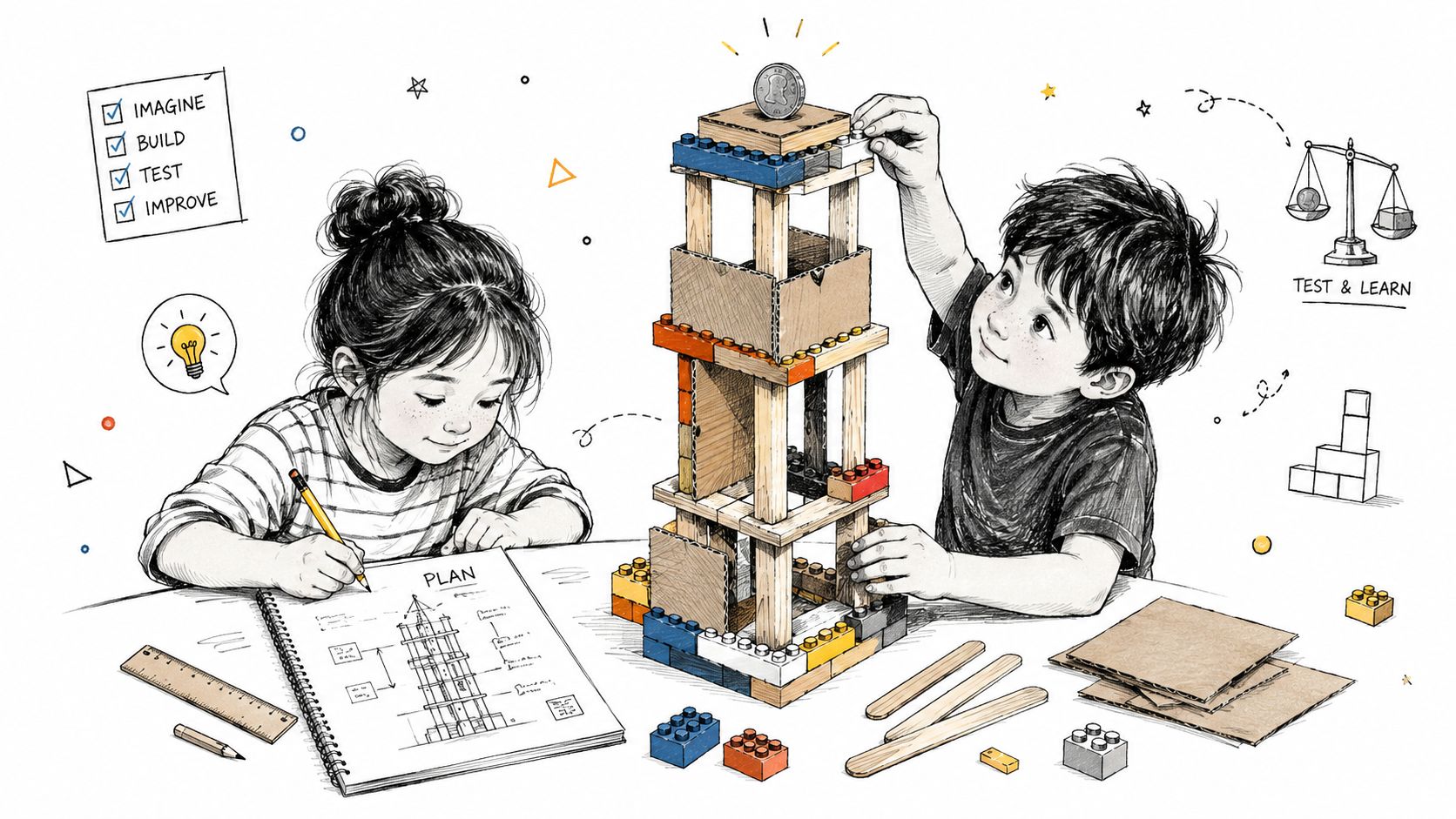
A good house version can be done with LEGO, cardboard, tape, paper cups, wooden blocks or K'NEX. At school, spaghetti bridge competitions and tower-building contests are popular because they're easy to judge against a clear goal. For a home challenge, ask children to build the tallest freestanding structure with a fixed pile of materials, then see whether they can strengthen it without starting again.
Practical rule: ask children to sketch before they build. Even a rough drawing slows them down just enough to think through the next step.
Materials: blocks, tape, paper, cardboard, cups, straws, recycled boxes or K'NEX.
Ages: 4+ for simple stacking, 7+ for bridges and more constrained builds.
Outcomes: spatial reasoning, engineering thinking, creativity and patience.
Adaptations: add weight limits, time limits or material limits for older children, or let younger children focus on height, shape or balance.
After the build, it helps to talk about why one version held better than another. That's where the learning sticks, because children start noticing structure, support and load rather than just the final look. If you want to extend the idea, compare it with how restaurants design cramped menus, prep stations and dining rooms in the city, since that same practical problem solving shows up in hidden gems across Manchester too.
5. Logic Puzzles and Sudoku
Logic puzzles are ideal when you want quiet concentration rather than movement. They train children to look for patterns, rule out impossible options and keep going when the answer isn't immediate. Sudoku is especially useful because it teaches systematic elimination, which is a simple habit children can reuse in maths, games and even packing a bag for school.
This kind of activity is portable and low-cost, which makes it easy to carry into waiting rooms, train journeys or a rainy afternoon at home. A child can work alone with a pencil, or a small group can talk through a puzzle together and compare strategies. If you want a themed entry point, use animals, food or sport-based logic puzzles so the rules feel playful rather than dry.
A good way in is to start with a very easy grid and let children cross out possibilities. Once they see that each answer narrows the next step, they begin to understand the structure, not just the finish line. For a family-friendly twist, try the fun guide to Clue Jr, which gives younger players a more story-led route into deduction.
- Begin with simpler grids: early success builds confidence.
- Use pencil, not pen: erasing is part of thinking.
- Offer hints, not answers: keep the child in charge of the solve.
- Use short sessions: five clean minutes beat a frustrated half-hour.
What children practise: pattern spotting, deductive reasoning, persistence and calm attention.
Best ages: about 6+, depending on the puzzle type.
How to adjust difficulty: reduce the grid size, add visual themes, or move from one-step clues to multi-step logic sets.
6. Cooking and Recipe Challenges
Cooking is one of the most useful problem solving activities for kids because the problem is real. Children have to follow steps, notice when something is off, swap ingredients if needed and decide what to do next, all while working toward something they can eat. It also brings in practical maths, because measuring, timing and dividing portions all matter.
The simplest format is a mystery box challenge. Put a few ingredients on the counter and ask children to make a snack, sandwich, salad or dessert topping from what's there. Older children can handle a Bake Off-style timed challenge, or a recipe swap where one ingredient is missing and they have to think of a sensible substitute. Food Escapes takes that same idea into the city, with a clue-led food experience across Manchester's independent restaurant scene, so the problem solving ends in a proper meal rather than a pretend prize.

Best use cases: rainy afternoons, school holidays, birthday activities and family cooking nights.
What you need: basic ingredients, child-safe tools, recipe cards, bowls and supervision.
Ages: 4+ for mixing and assembling, 8+ for more independent recipe decisions.
Learning gains: sequencing, resilience, sensory awareness and real-life numeracy.
Safety needs to come first, especially with knives, heat and food handling. Keep the challenge flexible, because the point is to solve the cooking problem, not to produce a perfect plate. Ask children to photograph the finished dish before eating it, then talk about what they'd change next time and why.
7. Word Games and Riddle Solving
Word games are brilliant when you want a challenge that travels well. A crossword, an anagram, a riddle or a quick rhyming game can fit into a car journey, a restaurant wait or a calm end to the day, and they build a different kind of thinking from physical tasks. Children learn to listen closely, play with meanings and notice that words can point in more than one direction.
Riddles are especially good for lateral thinking, because the answer is often hidden in plain sight. That makes them helpful for children who rush, guess or assume the first meaning is the only one. You can make the activity more engaging by choosing themes they already like, such as animals, football, food or Minecraft-style language.
A simple format is to read one riddle aloud, let the child think for a moment, then ask them to explain how they arrived at the answer. That explanation matters as much as the result. If they can describe why one interpretation didn't work, they're practising real reasoning.
Practical rule: ask children to write their own riddles once they've solved a few. Making the puzzle is often harder than solving it.
Examples to try: word searches, short crosswords, rhyming challenges, trivia for younger players and anagram races.
Materials: paper, pencil, puzzle book or a trusted app.
Best ages: 5+ for simple word play, older for more layered riddles.
How to adapt: shorten clues, use images with words, or pair a child with a partner for shared solving.
8. Science Experiments and Hypothesis Testing
Science experiments turn curiosity into a structured challenge. Children make a prediction, test it, watch what happens and decide what the result means, which is a very direct form of problem solving. That process also teaches them that a result they didn't expect still counts as useful information.
Simple kitchen chemistry works well, as do longer investigations like crystal growing, density towers, plant growth tracking or colour-changing reactions. The important part is not the drama of the setup, it's the habit of asking, “What do you think will happen?” before anything starts. That small pause changes the whole activity from play-acting science into proper thinking.
Write the prediction first. Children remember the comparison better when they can see what they expected and what actually happened.
Use familiar materials, keep the steps clear and let the child describe the result in their own words. If an experiment “fails”, don't rescue it too quickly. A wet volcano, a flat reaction or a wonky density tower still teaches observation, and kids often learn more from why something didn't work than from a neat success.
The routine is simple.
- Predict: ask what they think will happen.
- Test: run the experiment together.
- Notice: watch carefully and compare.
- Explain: talk through the result.
That cycle is what makes science one of the strongest problem solving activities for kids.
9. Map Reading and Navigation Challenges
Navigation challenges add movement, direction and decision-making all at once. Children use a map, compass or GPS to work out where they're going, which route looks best and how to recognise the next landmark, so the activity builds independence as well as spatial reasoning. It's also a practical way to help children feel more confident in their own neighbourhood.
Geocaching, orienteering in a local park and map treasure hunts in urban areas are all good fits. You can make it easier by staying in a familiar area first, then increasing the number of turns, clues or checkpoints. For families in Manchester, a route through nearby streets or green spaces can be especially engaging when the destination is something tasty, which is why Food Escapes works well here too, combining clue-solving and map-based navigation to guide families between three hidden-gem restaurants across the city.
What to use: printed maps, a compass, a phone with GPS as backup, and a safe route.
Best ages: 7+ for basic route work, older for more complex orienteering.
What children practise: route planning, landmark recognition, attention and confidence.
How to adapt: start with one landmark at a time, or build in clear check-in points for younger groups.
The value here is that children begin to see space as something they can read. They stop being passive passengers and become active route-finders, which is a powerful shift.
10. Group Collaboration and Team Challenges
Team challenges bring the social side of problem solving to the front. Children have to listen, negotiate, divide up the work and keep the group moving, which is why these activities are so valuable in classrooms, clubs and family gatherings. The classic examples are a human knot, blindfold partner navigation, relay-based problem solving and cooperative building tasks.
This kind of challenge works best when each child has a role that matters. Quiet children can be the clue-keeper, the checker, the timer or the person who spots details, so nobody gets sidelined by louder voices. Food Escapes is designed for that style of shared problem solving too, because friends, couples, families and corporate teams all have to solve clues together, explore Manchester as a unit and discover independent restaurants collectively. If you want a broader set of group formats, the fun team building ideas round-up fits neatly alongside this approach.
- Set roles upfront: that prevents one child from taking over.
- Mix the group: different personalities change how the team thinks.
- Reflect afterwards: talk about communication, not just the result.
- Celebrate effort: a team that kept calm and adapted has still succeeded.
The strongest group challenges leave children with a shared story. They remember who found the clue, who noticed the pattern and who helped everyone stay on track. That memory is part of the skill.
10-Item Comparison: Kids Problem-Solving Activities
| Activity | Implementation Complexity (🔄) | Resource Requirements (⚡) | Expected Outcomes (📊) | Ideal Use Cases (💡) | Key Advantages (⭐) |
|---|---|---|---|---|---|
| Treasure Hunt and Scavenger Hunts | Medium 🔄🔄, planned clue flow | Low-Moderate (⚡⚡), props, locations | Spatial awareness, teamwork, problem-solving 📊 | Outdoor parties, museums, family outings 💡 | Active exploration; scalable; memorable ⭐ |
| Escape Room Challenges | High 🔄🔄🔄, interconnected puzzles, timing | High (⚡), venue, props, staff | Logical reasoning, collaboration, time-management 📊 | Birthday groups, team-building, older kids 💡 | Immersive narrative; strong sense of achievement ⭐ |
| Coding and Programming Challenges | Medium 🔄🔄, scaffolded learning curve | Moderate (⚡⚡), devices, software, mentors | Computational thinking, debugging, creativity 📊 | After-school clubs, STEM lessons, robotics 💡 | Career-relevant skills; instant feedback; scalable ⭐ |
| Building and Construction Challenges | Medium 🔄🔄, design constraints, testing | Moderate (⚡⚡), materials, space | Spatial reasoning, engineering thinking, iteration 📊 | STEM days, mixed-ability groups, competitions 💡 | Tangible feedback; encourages experimentation ⭐ |
| Logic Puzzles and Sudoku | Low 🔄, rule-based, individual solving | Low (⚡⚡⚡), paper or apps | Deduction, concentration, systematic thinking 📊 | Quiet time, travel, enrichment activities 💡 | Portable; minimal setup; progressive difficulty ⭐ |
| Cooking and Recipe Challenges | Medium 🔄🔄, sequencing, safety teaching | Moderate (⚡⚡), kitchen, ingredients | Practical maths, planning, adaptation 📊 | Family activities, life-skills lessons, clubs 💡 | Edible results; real-world skills; sensory learning ⭐ |
| Word Games and Riddle Solving | Low 🔄, language-focused puzzles | Low (⚡⚡⚡), minimal materials | Vocabulary, lateral thinking, creativity 📊 | Travel, downtime, classroom warm-ups 💡 | Highly portable; fun; builds language confidence ⭐ |
| Science Experiments and Hypothesis Testing | Medium 🔄🔄, controlled procedures | Moderate (⚡⚡), materials, safety setup | Scientific method, observation, cause-effect 📊 | Classroom labs, home science sessions, enrichment 💡 | Evidence-based learning; curiosity-driven discovery ⭐ |
| Map Reading and Navigation Challenges | Medium 🔄🔄, route planning, safety | Moderate (⚡⚡), maps/apps, outdoor access | Spatial skills, independence, route planning 📊 | Orienteering, outdoor education, family outings 💡 | Real-world navigation; confidence building ⭐ |
| Group Collaboration and Team Challenges | Medium 🔄🔄, facilitation and roles | Moderate (⚡⚡), space, facilitator | Communication, leadership, social problem-solving 📊 | School groups, camps, team-building events 💡 | Builds empathy, negotiation, inclusive teamwork ⭐ |
Choose the Challenge That Fits Your Child
The best problem solving activities for kids are the ones that fit the mood you've got right now. If your child needs movement and exploration, pick a treasure hunt, a map challenge or a group clue trail. If they want quiet concentration, go for logic puzzles, riddles or coding. If they like making things, choose building or science. If they love practical life skills, cooking is hard to beat. If they thrive on social energy, escape rooms and team challenges are the natural choice.
The biggest gains usually come from starting at an achievable level. A child who can solve one clue, fix one code error or complete one easy build is far more likely to stay engaged than a child who's thrown straight into something too hard. Let them test ideas, change direction and explain what they noticed. That conversation after the activity is where the thinking settles in.
For a memorable family outing in Manchester, a clue-based outdoor activity pairs well with a food-led route, because children get movement, teamwork and a real reward at the end. Food Escapes fits that mix neatly, with a WhatsApp-led adventure that connects puzzle-solving, city discovery and independent food stops. If you want something that feels playful, local and different from the usual day out, it's worth exploring.
Food Escapes combines city clues, hidden-gem restaurants and a social route through Manchester in one WhatsApp-led adventure. It's a strong fit if you want problem solving activities for kids that end with proper food and a shared experience. Visit Food Escapes to see how the game works and plan a clue-led outing.

0 comments