


You're standing on a Manchester pavement with a half-finished coffee, three phones out, and a clue that appears to be pointing towards a restaurant none of you has noticed before. One friend is studying a shopfront, another is arguing that the answer must be hidden on a nearby plaque, and someone else is already wondering whether the next stop serves something they can eat. That slightly chaotic combination of walking, solving and eating is the modern round the world game at its most enjoyable.
The phrase can mean several different things, from a vintage card game to a basketball shooting drill or a classroom quiz. Today, though, people searching for a round the world game often want an urban adventure, a themed route through a city where each solved clue leads to another destination. It's part treasure hunt, part food experience, and part social competition. If you're comparing unusual date ideas, birthday activities, team-building options or things to do in Manchester, this is the version worth understanding first.
Table of Contents
- What a Round the World Game Actually Is
- From Tabletop to City Streets
- How Modern Round the World Games Work
- Popular Formats and Variations
- Why Food-Led City Trails Are the Standout Format
- Tips for Organising and Playing Your First Game
- Where to Play a Round the World Game in the UK
What a Round the World Game Actually Is
A modern round the world game usually puts a group at a starting point and sends them through a sequence of themed locations. The “travel” happens within a city rather than between countries, but the route can still evoke different cuisines, neighbourhoods and cultures. You might be decoding a clue outside a building, spotting a detail on a sign or following a riddle towards a hidden independent restaurant.
The best versions don't feel like someone has handed you a list of addresses. You earn the next stop. A clue might refer to a landmark, a word on a shopfront or a visual detail that you'd normally walk straight past. The group debates, tests theories and eventually gets that satisfying moment when the answer opens the next stage.

The name has a surprisingly broad history
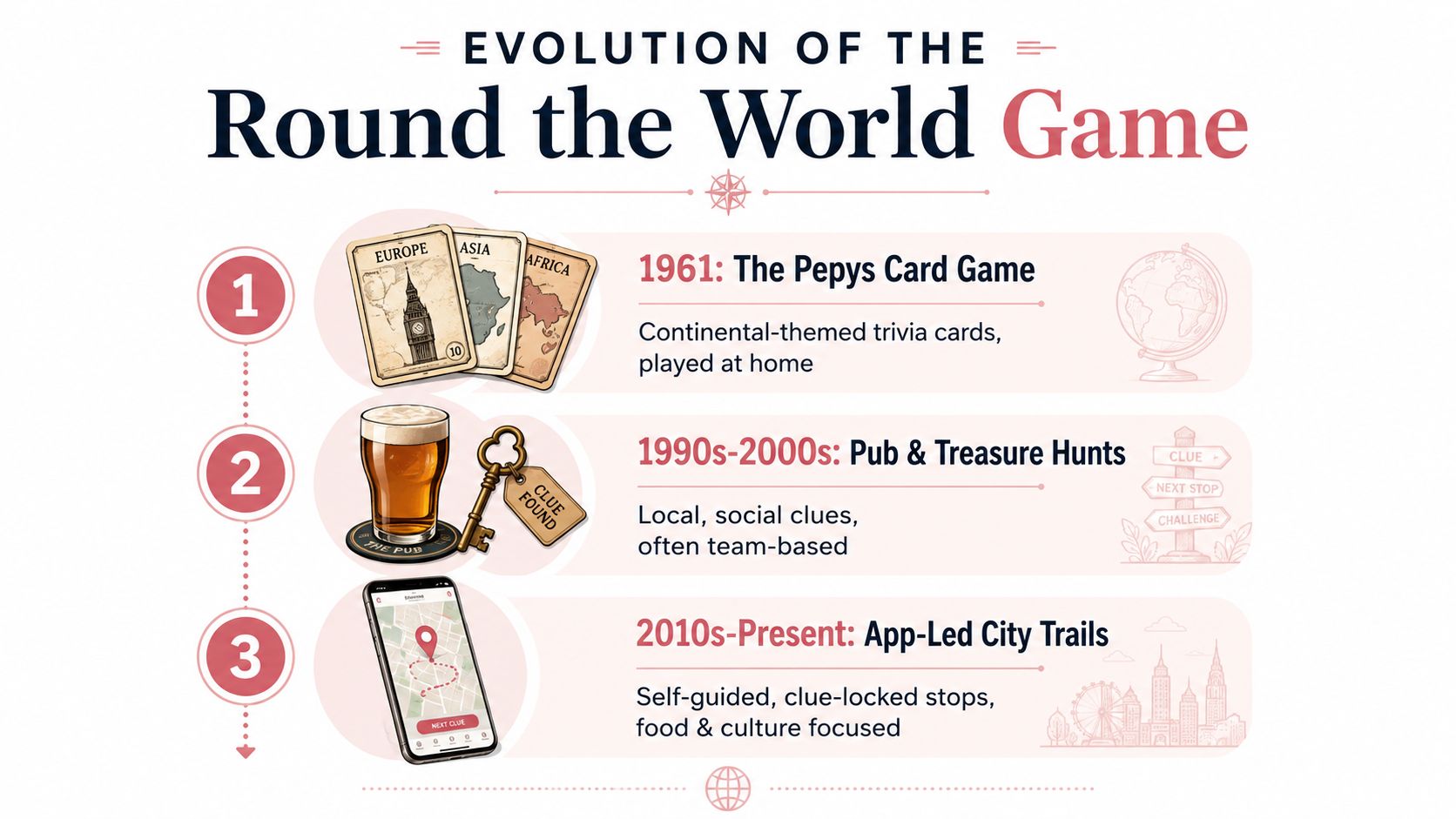
The term isn't exclusive to city trails. Round the World, a UK-produced card game, was published by Pepys, also known as Castell Brothers, in 1961, with a later edition released in the late 1960s. It used continent-based travel imagery and a speed-style matching mechanic, making it a distinctly educational British tabletop title of its period. You can see the original context in this history of the Pepys Round the World card game.
Basketball has its own Around the World format, while teachers have used the name for classroom review games. The shared idea is movement through a sequence. In one version, players move around shooting locations. In another, students progress from opponent to opponent by answering questions. On city streets, teams move from clue to clue, often with food acting as the reward.
That makes the format flexible. A couple can treat it as a playful date with conversation built in. Friends can turn it into a low-pressure competition. A company can use it for team-building without asking everyone to sit in a conference room or spend the evening in a pub. For extra inspiration when planning a spontaneous outing, these live deal discovery tips can help you find ideas worth pairing with a city adventure. Food-led examples are also collected in this guide to exploration games.
From Tabletop to City Streets
The original Pepys game worked because it made geography tangible. Players handled cards, recognised continent-themed imagery and raced to match information quickly. It turned the idea of travelling around the world into something that could happen around a table, with learning folded into play rather than delivered as a lecture.
Urban trails keep that basic promise but change the playing surface. The table becomes a city centre. Cards become clues delivered through a phone or booklet. A continent-themed picture becomes a real street, a restaurant sign, a historic building or a landmark detail. Instead of matching cards at home, players interpret the environment around them and decide where to go next.
Why self-guided play suits the format
The UK has developed a mature market for self-guided clue trails. Treasure Trails says it offers over 1,200 adventures across the UK, all self-guided, with no booking needed and flexible start times. Its UK self-guided trail model shows why this approach works operationally. Players don't need to coordinate with a live guide, wait for a fixed departure or keep an entire group available at one exact moment.
That flexibility matters for a round the world game. A route can operate asynchronously, fit around a meal or sightseeing plan, and continue without a guide managing every turn. It also makes repeat play more realistic because different city-centre routes can offer different themes and levels of discovery.
Technology has made the experience even smoother. A phone can deliver the clue, confirm an answer and point players towards the next stage. WhatsApp is especially useful because most groups already understand how to open messages, share photos and keep a conversation moving. The technology stays in the background, while the streets provide the atmosphere.
The format has endured because it preserves the strongest part of the tabletop game, a clear sequence with a reason to keep going, while adding movement, local character and shared decisions. You aren't reading about a destination. You're negotiating your way towards it.
How Modern Round the World Games Work
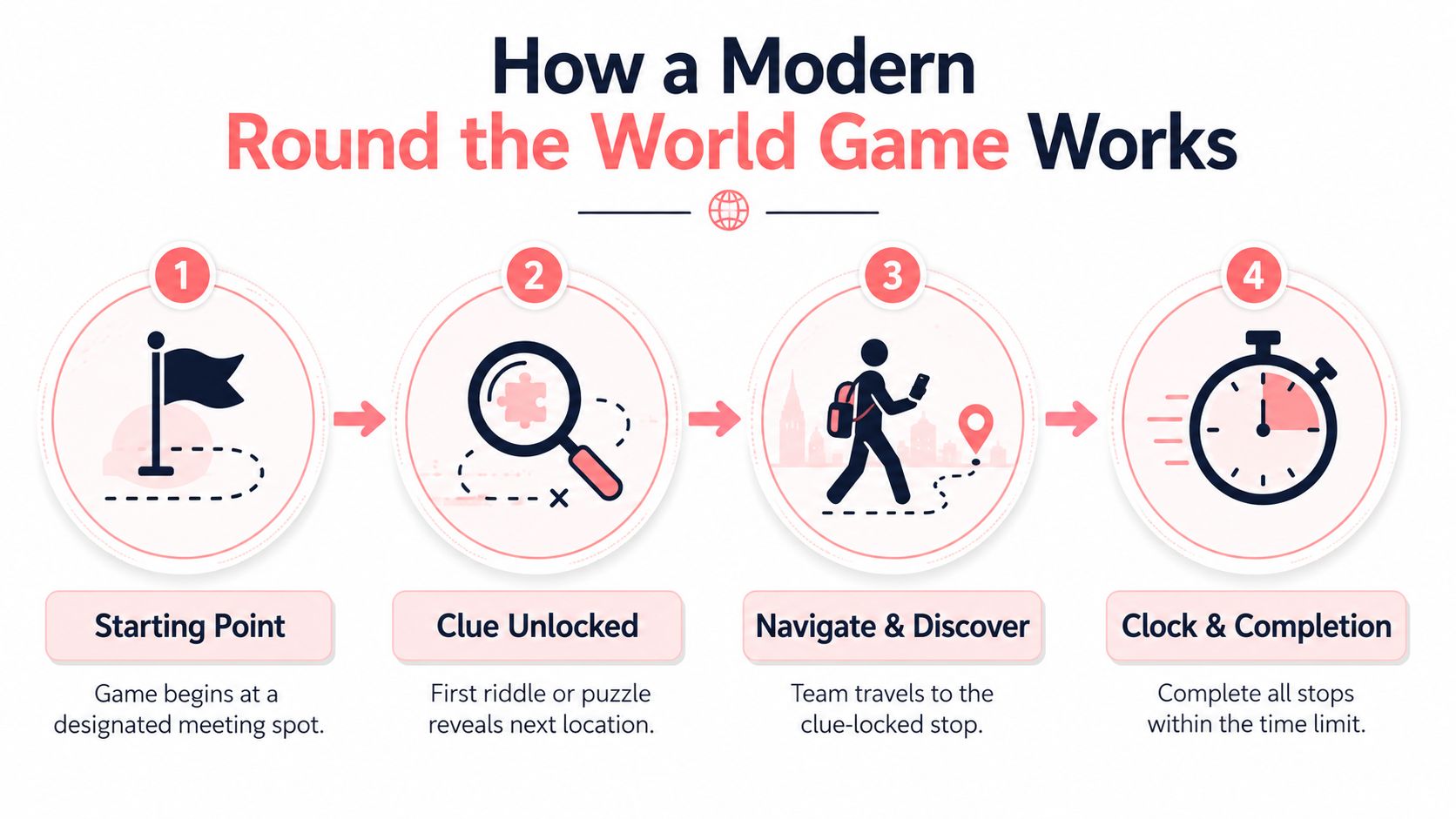
Most urban versions follow a straightforward loop. You meet at a designated starting point, receive the first clue, solve it together and travel to the location it reveals. At the destination, another clue or challenge keeps the route moving.
Independent UK walking-trail guidance says most puzzle trails involve around 2 to 4 kilometres of walking, with delivery through a phone, printed booklet, PDF or app. The same guidance describes clues based on environmental details such as plaques, shopfronts, buildings and landmarks in this overview of UK puzzle trails. That distance is manageable for many groups, but comfortable footwear still makes a difference, especially when your attention is divided between navigation and puzzle-solving.
The gameplay loop
- Start at the meeting point. Your booking or game instructions identify where the route begins. Arrive with enough time to check your phone and gather the group.
- Read the first clue carefully. Don't rush to the most obvious answer. Look around you, because the wording may rely on a physical feature nearby.
- Walk, inspect and discuss. Teams work best when one person leads, another reads the clue and others scan the surroundings. Passing the phone around keeps everyone involved.
- Proceed to the next stop. The answer reveals the next location, often a restaurant, landmark or themed destination. A clock may add friendly pressure, but the route should still leave room for conversation and discovery.
A charged phone is essential, as are mobile data and a backup charger if your group relies heavily on one device. The route depends on geospatial accuracy and readable clues, so players should avoid wandering too far before checking whether they've interpreted the instruction correctly.
What to expect from the group dynamic
The ideal group is large enough to generate ideas but small enough for everyone to hear the clue. Groups of two to six people are particularly easy to manage, though the right number depends on the route and the group's energy.
If you're new to the format, don't treat every clue like an exam. Try an answer, look for confirmation in the environment and let the game guide you. For a deeper look at the food-and-puzzle format, this guide to Food Escapes explains how solving clues can shape a city dining experience.
Popular Formats and Variations
Search for a round the world game and you'll find several activities sharing the same name. They aren't interchangeable. A basketball player wants repetition and accuracy, a teacher wants a lively review exercise, and a couple booking a city date may want food, movement and conversation.
| Format | Group Size | Duration | Setting | Best For |
|---|---|---|---|---|
| Basketball Around the World | Small group | Flexible practice session | Court or outdoor hoop | Competitive shooting |
| Classroom Around the World | Whole class | Lesson activity | Classroom | Reviewing questions |
| Card or board game | Family or friends | Home play | Living room or table | Traditional tabletop entertainment |
| Food-led city trail | Couples, friends or teams | Route-based outing | City centre | Dates, visitors and group experiences |
Basketball Around the World
The traditional basketball layout uses nine predetermined shooting locations: both low blocks, both short corners, both wings, both elbows and the free-throw line. A player must make a shot at each spot to win, as explained in this basketball Around the World rules guide.
A youth version from the Jr. NBA uses five shooting spots, with five shots from each spot. Each player takes 25 total shots, and the winner is the player who makes the most. The Jr. NBA version of Around the World suits a structured group session better than a casual city outing.
Classroom and tabletop versions
The classroom game turns progress into a race. The first student answers correctly, moves from one opponent to the next and eventually returns to their original seat. After each question, the next challenger replaces the student who lost, according to this classroom Around the World review-game explanation.
Card and board versions are better for rainy afternoons, family gatherings or anyone who enjoys travel themes without leaving home. They offer tactile play and a defined rule set, but they don't provide the surprise of discovering a real venue at the end of a clue.
The food-led city trail sits somewhere between a treasure hunt and a progressive meal. It suits people who want the name's travel flavour without booking flights, and it gives the group an activity to share before, between and after the food stops.
Why Food-Led City Trails Are the Standout Format
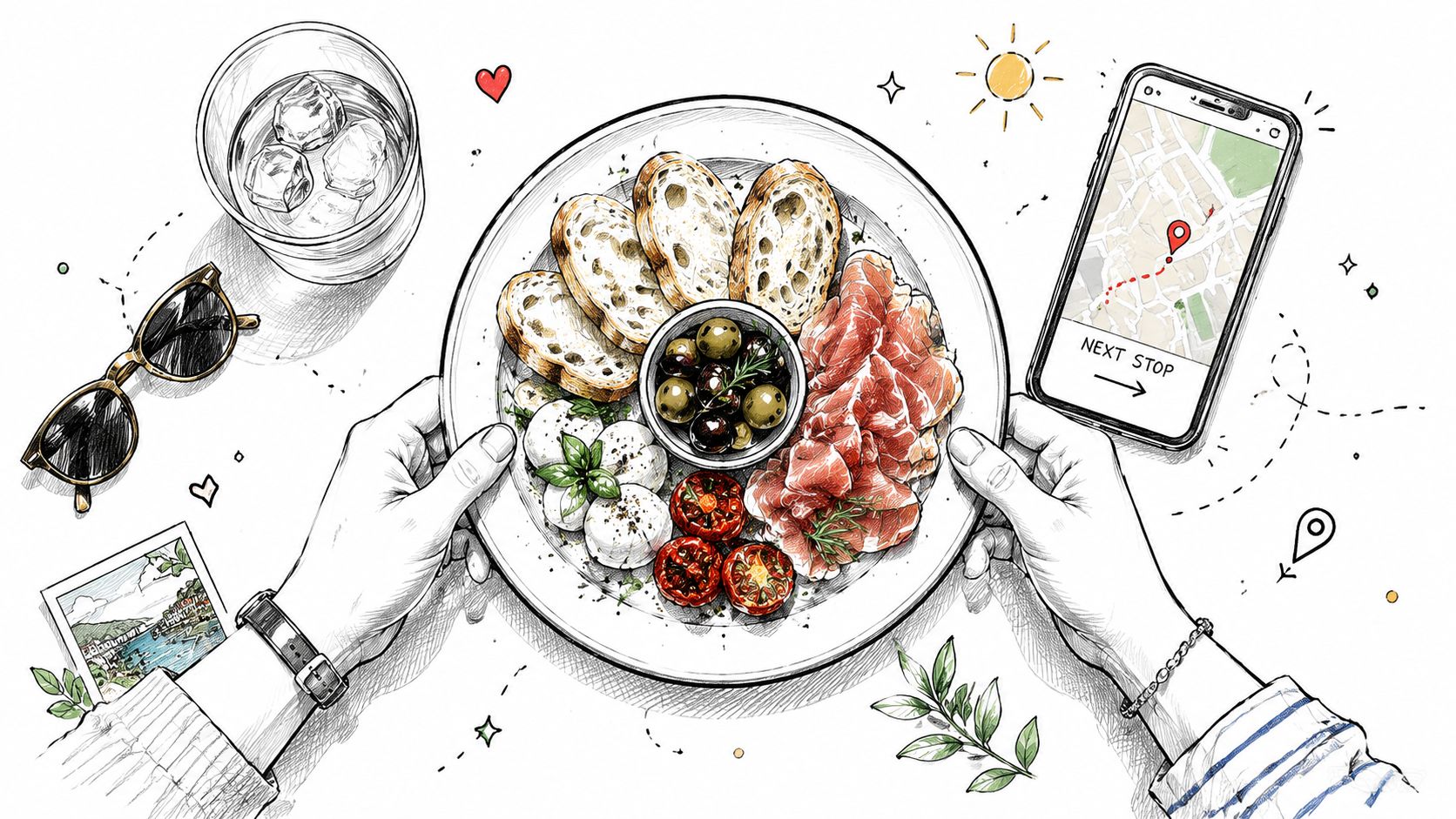
A food-led city trail solves a problem that many group activities leave untouched: people need a reason to keep participating. In a pub crawl, the social format can revolve around drinking. In an escape room, everyone stays in one place and the group's enthusiasm depends heavily on how much they enjoy enclosed puzzles. A food-led trail gives the team movement, conversation and a shared reward.
The structure also makes the stops feel useful rather than decorative. A restaurant becomes a rest point after a walk. The meal gives quieter members of the group time to join the conversation. Nobody has to perform constantly, yet the route still has a competitive edge when the clock is running.
A better fit for mixed groups
The format is especially strong for groups with different preferences. Non-drinkers can compete without having alcohol treated as the centre of the evening. Halal diners can look for routes and venues that accommodate their requirements. Families with older children get a puzzle with enough independence to feel exciting, plus food that breaks up the walking.
UK drinking habits make that flexibility increasingly relevant. The number of people planning an alcohol-free January more than doubled from 4.2 million in 2019 to 8.5 million in 2024, according to Alcohol Change UK's drinking trends fact sheet. The same source says that by 2024, 44% of UK drinkers using low or alcohol-free drinks did so in serious attempts to cut down. Those figures don't mean every group wants a dry activity, but they do challenge the assumption that a social night needs alcohol to work.
Food-led trails can also make a city feel more layered. A themed route might draw on dumplings, tacos, Southeast Asian flavours, Indian food or brunch, giving tourists a way to explore beyond the most obvious attractions. Local diners get a similar benefit, because the clues can lead them to independent restaurants they haven't yet tried.
That combination is hard to match. The group has something to solve, somewhere new to walk and a meal that doesn't require everyone to share the same drinking habits. The experience feels like travel, but the logistics stay local.
Tips for Organising and Playing Your First Game
A good round the world game doesn't need an elaborate plan. It needs a route the group can comfortably follow, a clear meeting point and enough practical preparation that small problems don't interrupt the fun.
Start with the people rather than the theme. A couple may enjoy taking their time with clues, while a larger work group may prefer teams and a little competition. Families should check walking expectations and food suitability before booking, especially if older children are joining.
A simple preparation checklist
- Choose comfortable clothing: Wear shoes suited to city walking, and check the forecast before setting out. A route can feel very different in rain, even when the clues are well designed.
- Charge the main phone: Bring a power bank if possible, and make sure the person holding the game has mobile data. A second phone can help with navigation without splitting the clue conversation.
- Agree on the pace: Let the group solve before rushing ahead. If there's a game clock, use it to add energy rather than turning every pause into a sprint.
- Check dietary needs early: Ask about halal-friendly choices, allergies, vegetarian requirements and alcohol-free preferences before committing to a food-led route. Clear information prevents awkward decisions at the first stop.
- Give everyone a role: One person can read, another can handle directions, another can inspect signs and someone else can keep the group moving. Rotate those jobs so one confident player doesn't take over.
Practical rule: The best team isn't the one with the loudest solver. It's the one that notices details, listens to different ideas and keeps the route enjoyable.
Self-guided play makes organising easier because there's no live guide whose availability controls the outing. Flexible start times also help corporate organisers fit an activity around meetings, travel and meal breaks. For broader event-planning ideas, these Monopack ltd party planning tips offer useful context for arranging a group occasion without overloading the schedule.
For a date night, keep the rest of the plan light. The game already supplies conversation and movement, so you don't need to book a packed itinerary afterwards. For a company team, explain the format in advance, share the meeting point and make dietary information easy to submit. Those small steps let the clues become the memorable part, rather than the logistics.
Where to Play a Round the World Game in the UK
Manchester is a strong place to try a modern food-led round the world game because the city packs independent restaurants, varied neighbourhoods and distinctive street details into a walkable urban setting. Food Escapes launched in Manchester in 2026 and offers themed escapes including Dumpling Trail, Rise & Dine Brunch, Los Tacos, Southeast Asia, Streets of the East, Indian Feast, Craft Beers and Comfort Cravings.
Each experience uses WhatsApp to deliver clues, guides players to three hidden-gem food stops and includes the food in the ticket. The clock creates friendly competition between locations, then pauses while the group sits down and enjoys the dishes. Routes can also suit friends, couples, families with older children and company teams, including groups looking for halal-friendly options or an outing without alcohol.
For readers outside Manchester, self-guided providers such as Treasure Trails offer routes across the UK. If you're specifically comparing local options, this guide to a Manchester treasure hunt helps show how a city route can combine discovery with a structured challenge.
Food Escapes turns the round the world game into a WhatsApp-led Manchester adventure, with clues, independent restaurants and themed food stops built into one social outing. Choose a Dumpling Trail, taco adventure, brunch route or another escape, then visit Food Escapes to book your first taste of the city's hidden gems.

0 comments